
Donburi Bowl Size Guide
 Choosing a donburi bowl might seem straightforward, but with so many sizes, materials, and styles to choose from, it’s easy to feel unsure about where to start.
The right bowl can make your meals feel more satisfying — and more authentically Japanese.
In this guide, we walk you through everything you need to know: from sizing and materials to care and history.
Big or small? Porcelain or stoneware? Classic or contemporary?
Read on to find the donburi bowl that’s just right for you.
At a Glance
• For classic donburi dishes like oyakodon and gyudon, go with a standard size (15–18 cm / 6–7 inches)
• For ramen, udon, and broth-based soups, choose a large size (18–20 cm / 7–8 inches)
• For kids, light portions, or desserts, a small size (10–14 cm / 4–5.5 inches) works perfectly
• Not sure? Start with 16–17 cm — it’s the most versatile size for everyday use
For Oyakodon, Gyudon & Classic Rice Bowls
 If you’re buying a donburi bowl for classic Japanese rice dishes, the standard size (15–18 cm / 6–7 inches) is the one to go for.
This is the size most commonly found in Japanese homes and restaurants — generous enough for a full serving of rice and toppings, with room to mix everything together as you eat.
Works well for:
• Oyakodon, gyudon, katsudon, tendon and other classic donburi dishes
• Everyday rice bowls with toppings
• Poke bowls, grain bowls, and other rice-based meals
Most people who are new to donburi bowls find this size to be exactly what they imagined — satisfying, versatile, and easy to handle at the table.
Related Products
For Ramen, Udon & Broth-Based Dishes
 For noodle soups and broth-based dishes, you’ll want to go larger. A large donburi bowl (18–20 cm / 7–8 inches) gives you the extra depth to keep broth contained and noodles from spilling over the sides. It’s also a great choice for big appetites or generous portions.
Works well for:
• Ramen and udon with a good amount of broth
• Large-portion donburi meals
•Meal prep bowls with lots of ingredients
• Sharing-style dishes placed in the center of the table
One thing to keep in mind: a large bowl filled to the brim can get heavy. If you plan to hold the bowl while eating, check the weight before committing — porcelain bowls in particular can feel quite substantial when full.
Related Products
For Smaller Portions, Kids & Desserts

If you’re buying for a child, or simply prefer a lighter meal, the small donburi bowl (10–14 cm / 4–5.5 inches) is a practical and often overlooked option. The deep, rounded shape also makes it a lovely choice for desserts.
Works well for:
•Kids’ meals with rice and a simple topping
• Light portions or side dishes alongside a multi-course meal
•Desserts like ice cream, fruit, or Japanese-style shaved ice (kakigori)
Pro tip:
Not sure where to start? Go with the standard size (around 16–17 cm). It works for the widest range of dishes and is the most versatile bowl you’ll reach for again and again.
Related Products
What Else Can You Use a Donburi Bowl For?
Donburi bowls were made for Japanese rice bowl dishes — but once you have one in your kitchen, you'll find yourself reaching for it far more often than you'd expect. The deep, wide shape and generous size make it one of the most versatile bowls you can own, whether you're cooking Japanese food or not.
Rice & Grain-Based Bowls

If you already love poke bowls, Buddha bowls, or meal prep bowls, a donburi bowl might just become your new go-to. The shape was practically made for this style of eating — deep enough to hold a generous base, wide enough to arrange toppings without everything piling on top of each other.
• Poke bowls
— The depth keeps everything neatly contained, and the wide opening
gives you plenty of room to arrange your toppings beautifully.
•Buddha bowls
— Grains, roasted vegetables, legumes, and a tahini or miso dressing all fit comfortably without the bowl feeling overcrowded.
• Bibimbap
— The Korean mixed rice dish with vegetables, gochujang, and a fried egg on top. A donburi bowl works perfectly for the home version.
• Grain bowls and meal prep
— Quinoa, farro, brown rice — whatever your base, a donburi bowl is the right size for a well-balanced, filling meal.
Beyond Rice — Soups, Salads & More
 This is where donburi bowls tend to surprise people. Once you start using one for non-rice dishes, it's hard to go back to a regular bowl.
•Soups and noodle broths
— The depth is ideal for keeping broth hot, and the wide mouth makes it easy to eat without hunching over.
• Salads
— A large donburi bowl works beautifully as a salad bowl, especially for hearty grain or noodle salads that need a bit of room to toss.
• Stews and curries
— Thick, chunky dishes that would slosh around in a shallow bowl sit perfectly in a donburi.
•Desserts
— A scoop of ice cream with fruit, or Japanese-style shaved ice (kakigori), looks right at home in a donburi bowl.
• Breakfast
— Smoothie bowls, oatmeal, yogurt with granola — the donburi bowl holds it all comfortably, with room to add toppings as you go.
How to Choose the Right Donburi Bowl for You
With so many options out there, choosing a donburi bowl can feel overwhelming. But it doesn't have to be. Once you know what to look for, the right bowl tends to reveal itself pretty quickly. Here are the key factors to consider.
Size: Match the Bowl to Your Appetite

This is the most important decision, and we've covered it in detail in the size guide above. But as a quick recap:
• If you eat smaller portions or are buying for a child, go with a small bowl (10–14 cm).
•For most people and most dishes, the standard size (15–18 cm) is the right choice.
• If you have a bigger appetite or love noodle soups, consider a large bowl (18–20 cm).
When in doubt, go standard. It's the most forgiving size and the one you'll reach for most often.
Weight: Light vs. Heavy Bowls

This is something a lot of people overlook — until they're holding a full bowl of ramen with one hand and wishing they'd paid more attention.
In Japanese dining tradition, it's common to lift smaller or standard-sized bowls while eating, but very large or heavy ramen bowls are often left on the table.
• Lightweight bowls (thin porcelain or fine ceramics) are comfortable to hold for extended meals and feel elegant in the hand. They tend to be more delicate, however, and require more careful handling.
• Heavier bowls (thick stoneware or earthenware) feel sturdy and substantial. They retain heat well, which is a real advantage for hot dishes. The trade-off is that they can feel tiring to hold over a long meal.
If you plan to use your donburi bowl at the table without lifting it, weight matters less. But if you eat in the traditional Japanese style, a lighter bowl will generally be more comfortable.
Shape and Depth
Not all donburi bowls are shaped the same. The two most common profiles are:
• Straight-sided bowls — A more contemporary look, with walls that rise fairly vertically from the base. These tend to feel modern and work well for Western-style bowl meals.
• Curved, flared bowls — The traditional donburi shape, with sides that curve outward toward the rim. This shape is ideal for mixing ingredients as you eat and feels natural in the hand.
Depth also varies more than you might expect. A deeper bowl is better for soupy dishes and anything with a lot of broth. A shallower bowl works well for drier dishes where presentation matters — the ingredients are more visible and easier to arrange.
Buying a Donburi Bowl as a Gift

A donburi bowl makes a thoughtful and practical gift, especially for anyone who loves Japanese food or enjoys cooking at home. A few things to keep in mind:
• Consider the recipient's cooking style. If they make a lot of noodle soups, a larger bowl will serve them better. If they tend to eat lighter meals, a standard or small size is ideal.
• A set of two is often more useful than one. Most people eat with at least one other person, so a matching pair is a practical and considerate choice.
• It's the gift they didn't know they needed. Most people already have everyday bowls in their kitchen — but very few have a proper donburi bowl. That's exactly what makes it such a great gift. It's not something most people would buy for themselves, yet once they have one, they'll wonder how they managed without it.
How Is a Donburi Bowl Different from Other Bowls?
If you're new to Japanese tableware, you might be wondering what actually sets a donburi bowl apart from the bowls you already own. The differences are more meaningful than you might expect — and understanding them makes it much easier to choose the right bowl for the right purpose.
Donburi Bowl vs. Rice Bowl (Chawan)
 These two are often confused, and it's easy to see why — both are used for rice. But they serve very different purposes.
A rice bowl (chawan) is small and designed to hold a single serving of plain steamed rice. It fits comfortably in one hand and is meant to be lifted to the mouth while eating. The typical chawan measures around 10–12 cm (4–5 inches) in diameter.
A donburi bowl, by contrast, is significantly larger. It's designed to hold rice plus a generous topping — meat, fish, egg, vegetables — all in one bowl. The extra depth and width are what make that possible. Where a chawan is about simplicity, a donburi bowl is about a complete, satisfying meal in a single vessel.
Donburi Bowl vs. Ramen Bowl
 Both are deep bowls, and both are used for substantial meals. The key difference is in how they handle liquid.
A ramen bowl is typically wider and shallower than a donburi bowl, with a broader, more open shape designed to accommodate a large volume of broth along with noodles and toppings. The wide surface area also helps keep the broth at the right temperature while you eat.
A donburi bowl is deeper relative to its width, which makes it better suited for rice-based dishes where you want the ingredients to stay contained and easy to mix. It can certainly be used for noodle soups — and many people do — but if ramen is your primary use case, a dedicated ramen bowl will serve you better.
Donburi Bowl vs. Western Serving Bowl
 A Western serving bowl and a donburi bowl might look similar at first glance, but they're designed with quite different intentions.
Western serving bowls are typically designed to sit on a table and be shared — they're wide, often shallow, and optimized for scooping food out rather than eating directly from. A donburi bowl, on the other hand, is designed for individual use. It's meant to be held, carried, and eaten from directly — which is why the proportions, weight, and depth are all calibrated for a single person's meal.
That said, a large donburi bowl works surprisingly well as a serving bowl for the table, especially for sharing rice or noodle dishes. The versatility is part of what makes it such a useful addition to any kitchen.
What Are Donburi Bowls Made Of?
The material a donburi bowl is made from affects everything — how it feels in your hands, how well it retains heat, how durable it is, and how it looks on the table. Here's a breakdown of the most common materials and what sets them apart.
Porcelain Donburi Bowls
 Porcelain is the most popular material for donburi bowls, and for good reason. It's smooth, non-porous, and fired at a high temperature, which gives it a clean, refined finish that works equally well in casual and formal settings.
What makes porcelain a good choice:
• Light and comfortable to hold, even when the bowl is full
• Non-porous surface resists staining and odor absorption
• Many are dishwasher-safe, but always check the manufacturer's instructions
• Works well in the microwave
• The smooth surface is easy to wipe clean and rinse
Porcelain donburi bowls tend to have a crisp, polished look, sometimes with painted designs or patterns. If you want a bowl that looks elegant and is easy to maintain, porcelain is hard to beat.
The main trade-off is fragility. Porcelain is more prone to chipping than stoneware, so it requires a little more care when stacking or washing.
Related Products
Stoneware Donburi Bowls
 Stoneware is fired at a lower temperature than porcelain, which results in a denser, heavier material with a more rustic, textured appearance. It's the material most associated with traditional Japanese hand-crafted ceramics.
What makes stoneware a good choice:
• Excellent heat retention — keeps food warm for longer
• Durable and resistant to chipping
• The matte, earthy aesthetic suits traditional Japanese table settings beautifully
• Each piece often has subtle variations in color and texture, giving it a handmade character
The trade-off with stoneware is weight. A stoneware donburi bowl filled with rice and toppings can feel quite heavy, which matters if you prefer to hold your bowl while eating. Some stoneware is also not suitable for the dishwasher or microwave, so it's worth checking before you buy.
Light vs. Heavy: Which Is Right for You?
![[UTSUWABI Special Order] Donburi Bowl Silver L | Mino Ware-Detail7](https://cdn.shopify.com/s/files/1/0824/8413/4185/files/182004770_o7.jpg?v=1734686537) This comes down to how you eat and what you value in a bowl.
This comes down to how you eat and what you value in a bowl.
•Choose porcelain if you want something lightweight, easy to clean, and versatile enough to use every day. It's also the better choice if you plan to use the microwave.
•Choose stoneware if you prioritize heat retention, durability, and the kind of rustic, handcrafted aesthetic that makes a bowl feel special on the table.
Many people end up owning both — a porcelain bowl for everyday use and a stoneware bowl for when they want to slow down and enjoy the experience of eating from something a little more considered.
How to Care for Your Donburi Bowl
A well-made donburi bowl can last for decades if you treat it with a little care. The good news is that most donburi bowls are straightforward to maintain — it's really just a matter of knowing a few basics.
Before Your First Use: Seasoning a Stoneware Bowl
 If your donburi bowl is made from stoneware, it's worth taking one simple step before you use it for the first time: seasoning the bowl. In Japanese, this is called medome — a traditional practice that helps protect the bowl and extend its life.
Stoneware has tiny, microscopic pores in its surface that can absorb water, food colors, and odors over time. Seasoning fills those pores before your first use, making the bowl more resistant to staining and easier to keep clean in the long run.
It's not strictly required, but it's a small investment of time that pays off over years of use — and it's a nice way to start a relationship with a new piece of pottery.
How to season your stoneware donburi bowl:
1. Place the bowl in a pot and add enough water to fully submerge it.
2. Add about 1 tablespoon of plain flour or potato starch and stir to dissolve.
3. Heat on low to medium heat for 15–20 minutes. Keep the heat gentle — a rolling boil can cause the bowl to knock against the pot and chip. If you're seasoning multiple bowls at once, place a piece of kitchen paper between them.
4. Turn off the heat and leave everything to cool down naturally. This can take a while, so doing it before bed and letting it cool overnight works well.
5. Once cool, remove the bowl, rinse off any starchy residue, dry thoroughly, and it's ready to use.
Porcelain bowls do not need seasoning — a simple rinse before first use is all they need.
Everyday Care
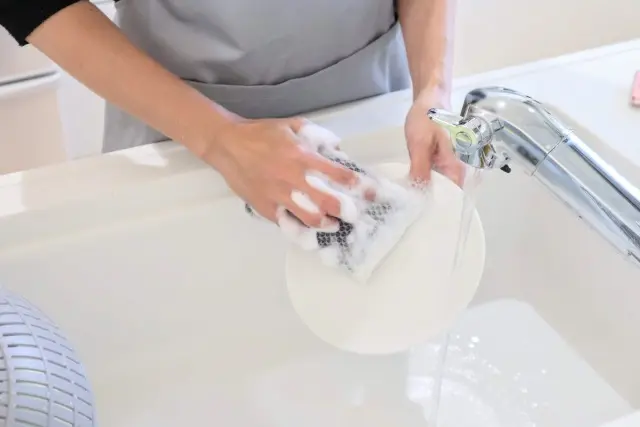 For day-to-day use, donburi bowls are easy to look after.
•Wash with a soft sponge and mild dish soap. This is all you need for most meals. Avoid abrasive scrubbers or scouring pads, which can scratch the surface or damage painted designs over time.
• Don't leave food sitting in the bowl for long periods. Even after seasoning, oils and sauces can gradually work their way into stoneware if left for a while. Rinse or wash promptly after use.
• Dry thoroughly before storing — including the base. Donburi bowls are deep and thick, so they take longer to dry than shallower dishes. Pay attention to the bottom of the bowl, where moisture can collect and cause musty odors if left damp.
• Stack carefully. If you're stacking multiple bowls, place a soft cloth or piece of kitchen paper between them to prevent scratching or chipping. Try to keep stacks to five bowls or fewer.
Dishwasher & Microwave Use

• Always check the manufacturer's instructions first. This applies to both dishwashers and microwaves — what's safe for one bowl may not be safe for another.
•Bowls with metallic decoration — gold or silver trim, gilded patterns — should never go in the microwave. The metal can cause sparks, damage the bowl, and create a potential fire hazard. Keep these out of the dishwasher as well to preserve the finish.
• Bowls with hand-painted or delicate designs are best washed by hand with a soft sponge to keep the decoration looking its best.
•In the dishwasher, make sure the bowl isn't touching other items. Donburi bowls are larger and heavier than most dishes, and contact with other items during the wash cycle can cause chips or cracks.
What Is a Donburi Bowl, Anyway?
 If you've arrived at this guide already knowing what a donburi bowl is, feel free to skip ahead. But if you're coming to Japanese tableware for the first time — or you've heard the word "donburi" without being entirely sure what it refers to — this section is for you.
Donburi: Japan's Original One-Bowl Meal
Donburi (丼) refers to both a style of dish and the bowl it's served in. As a dish, it's simple: a bowl of steamed rice with a topping — usually a protein, sometimes a sauce, often both — served together in a single vessel. No side plates, no separate components. Everything in one bowl.
It's a style of eating that has been central to Japanese everyday life for well over a century, and it remains one of the most popular ways to eat in Japan today. Walk into any casual restaurant in Japan and you'll find at least one donburi on the menu — usually several.
The appeal is easy to understand. Donburi is filling, fast to prepare, endlessly adaptable, and deeply satisfying. It's comfort food, but it's also practical food.
Why Donburi Bowls Are Deeper Than Regular Bowls
The shape of a donburi bowl isn't accidental. It's designed specifically for this style of eating.
A donburi bowl needs to hold a full serving of rice — already a substantial base — plus a generous portion of topping. That topping often comes with a sauce or broth that needs to be contained. And the whole thing needs to be easy to eat from, whether you're holding the bowl in one hand or leaving it on the table.
The result is a bowl that's noticeably deeper and wider than a standard Western cereal bowl or soup bowl. The depth keeps the contents contained and the broth from splashing. The width gives you room to mix the topping into the rice as you eat — something many donburi dishes are designed for. And the size overall ensures a satisfying, complete meal in a single vessel.
A Brief History of Donburi
Donburi as a style of cooking first appeared in Japan during the Edo period (1603–1868), when fast, affordable meals served over rice became popular in the cities. The earliest donburi dishes are said to have originated with "Tokidaineshi" in the Muromachi period, but the modern style became popular in the Edo period with dishes like "Unadon" (eel bowl).
Over time, specific donburi dishes developed their own identities and devoted followings. Gyudon (beef bowl) and oyakodon (chicken and egg bowl) became staples of everyday Japanese life. Tendon (tempura bowl) and unadon (eel bowl) became more celebratory dishes, associated with special occasions.
Today, donburi encompasses everything from quick weekday lunches at chain restaurants to carefully crafted bowls at specialty restaurants that focus on a single dish. The format has also spread internationally, with poke bowls, grain bowls, and rice bowls around the world drawing on the same basic idea: a satisfying, complete meal built in a single bowl.
Shop Authentic Japanese Donburi Bowls
Now that you know what sets donburi bowls apart — from size and materials to the many ways they can be used — finding the right one becomes much more straightforward.
Authentic Japanese donburi bowls bring together considered design and everyday practicality. Whether you're drawn to refined porcelain or the warm, handcrafted character of stoneware, there's a bowl that will feel at home in your kitchen and on your table.
If you're still deciding, think back to the key questions from this guide: What size fits your appetite? How much do weight and heat retention matter to you? Will you be using it for classic donburi dishes, modern grain bowls, or both? The answers will point you to the right bowl.
Browse our collection of authentic Japanese donburi bowls:
Donburi list page
You may also be interested in exploring other Japanese bowl collections:
Or browse our full Japanese bowl collection for the widest selection:
Bowl list page
Every piece in our collections is carefully selected for craftsmanship, durability, and everyday usability — so you can bring a little of the beauty of Japanese tableware into your own home.